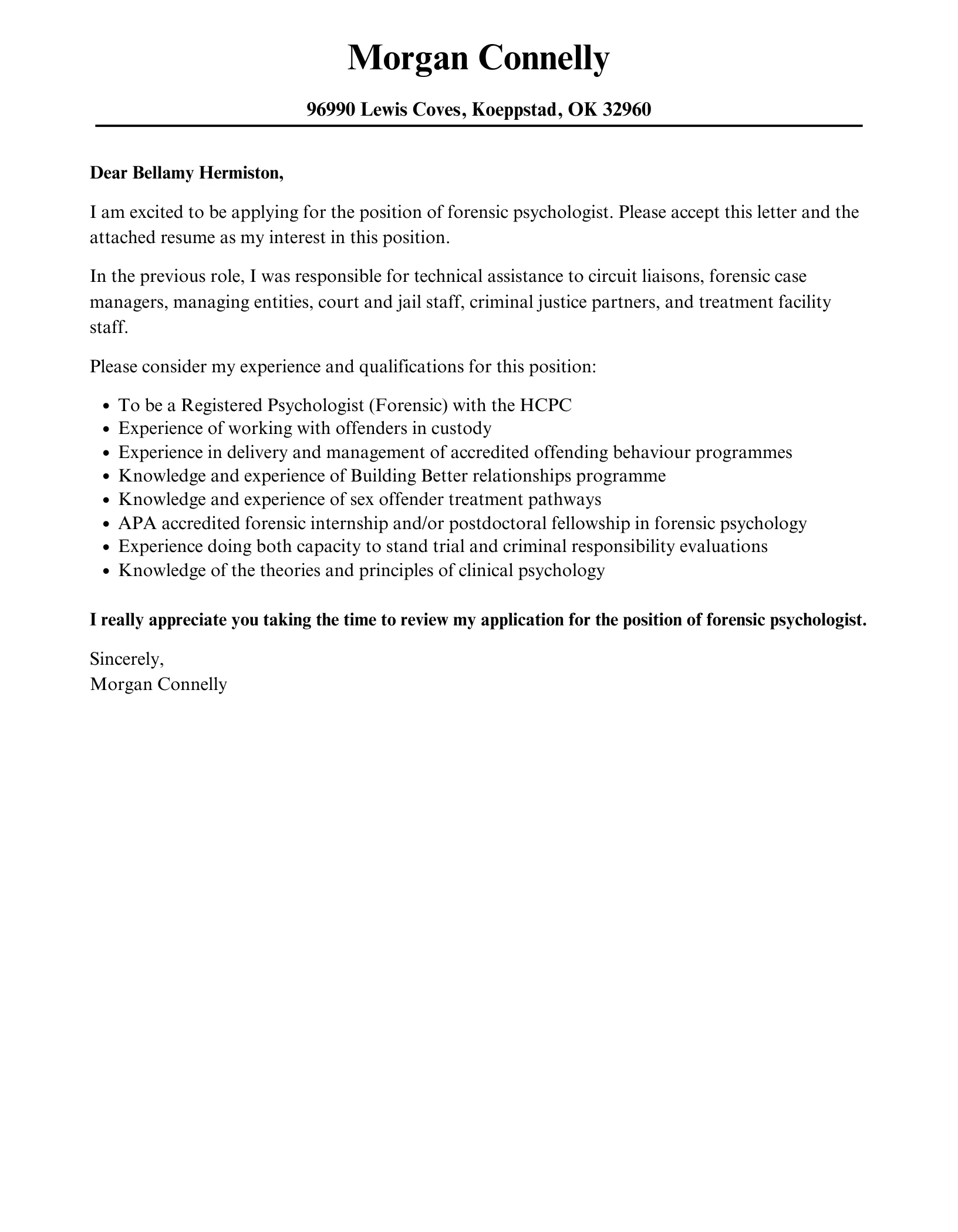
Crafting a Winning Forensic Scientist Cover Letter
A cover letter is your first opportunity to make a strong impression and distinguish yourself from other applicants. For a forensic scientist, the cover letter is even more critical because it not only highlights your skills and qualifications but also demonstrates your attention to detail, analytical thinking, and communication abilities. It’s not just a formality; it’s a crucial part of the application process that can significantly impact whether you get an interview. A well-crafted cover letter provides context to your resume, allowing you to showcase how your experience and skills align with the specific requirements of the job. It enables you to tell your story, explaining your motivations and demonstrating your passion for forensic science and the specific role you’re applying for. This article delves into the top five tips to make your cover letter stand out and help you land your dream job.
Highlighting Your Forensic Science Skills
The core of a compelling cover letter lies in showcasing your relevant skills. Forensic science demands a diverse skill set, so it’s essential to focus on those most pertinent to the job. Begin by thoroughly reviewing the job description and identifying the skills the employer values most. Highlight skills such as analytical reasoning, attention to detail, problem-solving, and proficiency in specific forensic techniques (e.g., DNA analysis, toxicology, ballistics). Use specific examples to illustrate how you’ve successfully applied these skills in previous roles. Instead of just listing your skills, provide brief anecdotes that showcase your abilities in action. For example, describe how you used your analytical skills to solve a complex case or how your attention to detail led to the accurate identification of evidence. Moreover, tailor your skill descriptions to match the job requirements. If the job emphasizes DNA analysis, emphasize your proficiency and experience in that area. If the role involves crime scene investigation, focus on your skills in evidence collection and documentation. By aligning your skills with the job’s needs, you demonstrate that you are a well-suited candidate.
Showcasing Relevant Education and Certifications

Education and certifications are fundamental to a forensic scientist’s credibility. In your cover letter, clearly state your educational background, including the name of your degree (e.g., Bachelor of Science in Forensic Science), the institution, and the graduation date. If you have advanced degrees, such as a Master’s or PhD, make sure to highlight them prominently. Include any relevant certifications, such as those from the American Board of Criminalistics (ABC) or other professional organizations. These certifications validate your expertise and demonstrate your commitment to professional development. Mention any specialized training or courses that are relevant to the job. For example, if the job requires experience in digital forensics, mention any training or certifications you have in that area. If you have any academic achievements, such as Dean’s List or scholarships, include them to demonstrate your academic excellence. This is crucial for showing you have met the educational requirements for the forensic science field.
Emphasizing Experience in Forensic Science
Experience is a cornerstone of a successful forensic science career. When describing your experience, focus on your previous roles, the responsibilities you held, and the results you achieved. Use the job description to guide you, selecting the experiences that align with the employer’s needs. Provide details about the types of cases you’ve worked on, the techniques you’ve used, and the tools and equipment you’re proficient with. Quantify your experience whenever possible; for example, mention the number of cases you’ve handled, the types of evidence you’ve analyzed, or the size of the team you’ve worked with. If you’ve held a leadership position, describe your responsibilities and the impact you had on the team or organization. For instance, you could mention how you trained new team members, improved laboratory procedures, or managed complex investigations. Highlight any specialized experience that matches the job description, such as expertise in a specific area of forensic science or experience working in a particular type of laboratory or setting. Your goal is to provide a clear, concise, and compelling overview of your professional background to showcase your suitability for the position.
Quantifying Your Achievements
Quantifying your achievements makes your cover letter more compelling and provides concrete evidence of your capabilities. Instead of merely stating what you did, provide specific data and metrics to illustrate your accomplishments. Use numbers to show the impact of your work. For example, if you improved the efficiency of a process, state the percentage of improvement or the amount of time saved. If you contributed to solving cases, mention the number of cases or the types of cases you helped solve. If you’ve received awards or recognition, include them in your cover letter. Also, if you’ve been involved in any publications or presentations, list them to demonstrate your expertise and contributions to the field. By providing these specifics, you make your achievements more tangible and demonstrate the value you can bring to the employer. Remember to tailor your achievements to the specific job description, highlighting those that align with the role’s requirements and responsibilities. Quantifiable achievements clearly demonstrate your effectiveness and distinguish you from other candidates.
Using Action Verbs in Your Cover Letter

Action verbs make your cover letter more dynamic and engaging. They add energy to your writing and help to showcase your accomplishments and skills. Instead of using passive language, begin sentences with strong action verbs that clearly describe your role and responsibilities. Start your sentences with words like ‘analyzed,’ ‘conducted,’ ‘managed,’ ‘investigated,’ ‘developed,’ ‘implemented,’ ’trained,’ ‘supervised,’ and ‘coordinated.’ These verbs immediately convey your active involvement and highlight your contributions. When describing your experience, use these verbs to emphasize your achievements and responsibilities. For example, instead of writing ‘Responsible for analyzing evidence,’ write ‘Analyzed evidence to identify key findings.’ This approach creates a more vivid and compelling picture of your capabilities. Vary your verb choices to keep your writing interesting and to demonstrate the breadth of your skills. Use a thesaurus to find synonyms that accurately and effectively describe your actions. Make sure your language is precise and reflects the specific skills and responsibilities outlined in the job description. This will make your cover letter more persuasive and memorable.
Tailoring Your Cover Letter to the Job Description
Researching the Employer
Researching the employer is a crucial step in creating a compelling cover letter. Before you begin writing, take the time to learn about the organization, its mission, values, and the specific role you’re applying for. Visit the employer’s website, read their publications, and check their social media presence. This research helps you understand their needs and priorities, enabling you to tailor your cover letter to their specific requirements. Understanding the employer’s culture is crucial. If the organization emphasizes teamwork, make sure to highlight your collaborative skills and experience. If they prioritize innovation, showcase any innovative approaches you’ve taken in your previous roles. Knowing the employer’s values lets you align your skills and experiences with their mission. Personalizing your cover letter to the employer shows that you are genuinely interested in the position and have invested time in understanding their needs.
Addressing the Specific Requirements

Carefully addressing the specific requirements listed in the job description is key to a successful cover letter. Read the job description thoroughly, and identify the key skills, qualifications, and experiences the employer is looking for. Use the job description as a roadmap, ensuring that you address each requirement directly and provide evidence of your abilities. Structure your cover letter to mirror the job description, and address the requirements in a logical order. For each requirement, provide a specific example from your experience or education that demonstrates your proficiency. If the job description mentions proficiency in a particular software or technique, make sure to highlight your relevant experience. Tailor your language to match the tone and terminology used in the job description. If the description emphasizes teamwork and collaboration, use examples of your teamwork experiences. By directly addressing each requirement, you demonstrate that you possess the skills and qualifications the employer is seeking, increasing your chances of getting selected for the interview.
Matching Keywords and Skills
Use keywords and skills from the job description throughout your cover letter to optimize it for the hiring manager’s attention. Carefully analyze the job description to identify the keywords and phrases the employer uses to describe the ideal candidate. These keywords often highlight the essential skills, qualifications, and experiences the employer values. Incorporate these keywords naturally into your cover letter, particularly in the introduction, skill descriptions, and experience sections. Use a variety of synonyms and related terms to avoid sounding repetitive while still conveying your core strengths. However, do not engage in keyword stuffing. Use the keywords naturally and in context, ensuring that your writing flows smoothly and remains readable. By strategically using keywords, you help the hiring manager quickly recognize that you possess the desired skills and qualifications. This can significantly improve your chances of your application being noticed and of getting an interview.
Formatting and Presentation Tips
Professional Formatting

The formatting and presentation of your cover letter significantly impact its readability and professionalism. Use a clean, professional font, such as Times New Roman, Arial, or Calibri, and maintain a consistent font size (11 or 12 points). Ensure that your cover letter is well-organized, with clear headings, subheadings, and bullet points to break up large blocks of text. Use proper margins (1 inch on all sides) and spacing (single or 1.15 line spacing) to make your cover letter visually appealing. Keep the cover letter concise, ideally no more than one page, unless specifically requested otherwise. Include your contact information at the top of the cover letter, including your name, phone number, email address, and LinkedIn profile URL. Proofread your cover letter carefully for any grammatical errors or typos, using a grammar checker. Ensure that the cover letter’s formatting aligns with your resume and other application materials to create a cohesive and professional presentation. A well-formatted cover letter reflects your attention to detail and professionalism, leaving a positive impression on the employer. Make sure your cover letter is easily readable and visually appealing.
Proofreading and Editing
Proofreading and editing are critical steps in ensuring your cover letter is polished and error-free. After you’ve written your cover letter, take the time to carefully review it for any grammatical errors, spelling mistakes, or typos. Use a grammar checker to catch any errors you might have missed. Read your cover letter aloud to yourself or have someone else read it to you. Sometimes, hearing your words aloud can help you spot mistakes that you might not notice when reading silently. Make sure that your language is clear, concise, and professional. Ensure that your sentences are well-structured and that your ideas flow logically. Check for consistency in formatting, such as font, font size, and spacing. Be sure to verify all contact information is accurate. If possible, have a friend, colleague, or career advisor review your cover letter for feedback. Another pair of eyes can often catch errors or suggest improvements that you might have missed. A well-proofread and edited cover letter demonstrates your attention to detail and enhances your overall professionalism.
Contact Information and Salutation
Providing accurate and professional contact information, alongside a formal salutation, is essential in your cover letter. At the top of your cover letter, include your full name, phone number, email address, and LinkedIn profile URL. Make sure your email address is professional, using your name or a variation of it. Start your cover letter with a formal salutation, such as “Dear Mr./Ms. [Last Name],” when the hiring manager’s name is available. If you are unsure of the name, use “Dear Hiring Manager” or “Dear [Department Name] Hiring Team.” Avoid informal salutations such as “To Whom It May Concern.” In your closing, use a professional closing, such as “Sincerely,” “Respectfully,” or “Best regards.” Include your full name below the closing. Ensure that your contact information is easy to read and that you respond to any correspondence promptly. This enhances your professionalism and shows that you value the opportunity.
Final Thoughts and Next Steps

A well-crafted cover letter is a powerful tool that can significantly enhance your job application, particularly for a forensic scientist position. Following these top five tips – highlighting your skills, showcasing relevant experience, quantifying achievements, tailoring your letter to the job, and paying close attention to formatting – can help you create a cover letter that stands out. Always tailor your cover letter to each job application, highlighting the skills and experiences most relevant to the specific role. Proofread your cover letter meticulously to ensure it is error-free. Your cover letter should demonstrate your passion for forensic science and explain why you are the best candidate for the job. By investing time and effort in crafting a compelling cover letter, you significantly increase your chances of landing an interview and taking the next step in your forensic science career. Prepare to receive the job, and remember to follow up on your application after the stated time period.